
Rudolph Logistik: Clean Data Is the Basis for Clean Air
In this interview, Andreas Pfeiffer, responsible for energy and climate management at the Rudolph Logistik Gruppe headquartered in Gudensberg, talks about the challenges and strategies for reducing greenhouse gas emissions in intralogistics. Pfeiffer calls for standardized data from industrial truck manufacturers and stresses that a reliable fleet management system such as Mobile Easykey is essential for tracking energy consumption and emissions in detail.
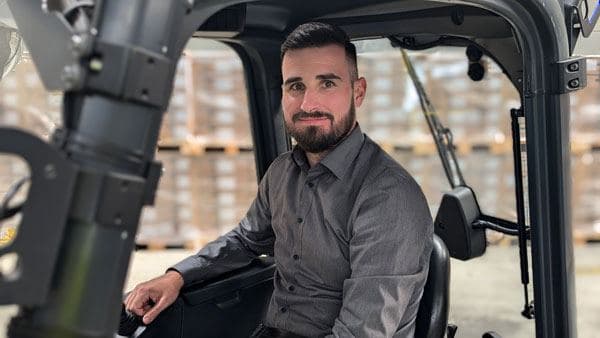
Mr. Pfeiffer, at the Rudolph Logistik Gruppe you are responsible for the logistics company's energy and climate management: energy procurement, monitoring and optimization. A complex subject, in other words. What title would you give your work?
Andreas Pfeiffer: That is where it starts. I am responsible for energy and climate management at the Rudolph Logistik Gruppe, and that also includes the topic of greenhouse gas neutrality. Every company and every institution uses different terms. Climate management, energy management, CO2, greenhouse gas, climate gas. The sheer variety of terms and approaches already shows how differently this complex subject is still being tackled today.
So how is it tackled at Rudolph?
Andreas Pfeiffer: Our basis is certification in accordance with DIN EN ISO 50001. The focus is on reducing energy consumption, which as a rule also leads to a reduction in greenhouse gas emissions. The question of the footprint of the industrial truck fleet and of each individual forklift is becoming more and more important. The EU wants to be climate-neutral by 2050, Germany even by 2045.
So you only have electric forklifts and green electricity at all your sites?
Andreas Pfeiffer: If only it were that simple. First of all, yes, the majority of our industrial trucks are electrically powered, plus a few diesel vehicles and a few more that run on LPG. Since we started paying closer attention to the footprint of the individual machines, we have, for example, replaced diesel forklifts with electric ones and were able to cut greenhouse gas emissions for these machines by up to 90 percent. However, we also have to include the emissions generated during manufacturing. That is still a blind spot today. I am not aware of any industrial truck manufacturer that provides the relevant data.
What do you need this data for?
Andreas Pfeiffer: According to the Greenhouse Gas Protocol, emissions can be broken down as follows: Scope 1 covers the greenhouse gases generated on our premises, such as from burning diesel or gas. Scope 2 is grid energy, primarily electricity. Scope 3 is everything else, for example manufacturing and disposal. We can already record Scope 1 and 2 quite well today. We know the greenhouse gas values for a liter of diesel or a kilogram of gas, and we know the electricity mix at our sites. But when we purchase a new vehicle, we are also buying a greenhouse gas backpack. To what extent our company has to carry it, or whether part of it is passed on when the vehicle is sold later: that too is still completely unclear to date. So we need this figure and uniform rules on how this quantity is to be allocated over the service life in order to eventually produce transparent and traceable greenhouse gas accounting.
Scope 2 for electric forklifts: Which values exactly do you work with?
Andreas Pfeiffer: Linde, for example, states an average kilowatt-hour consumption based on the VDI cycle. Jungheinrich even states a CO2 consumption. However, the CO2 consumption figure is vague, because it is based on an electricity mix that may not reflect the actual situation at our sites at all. And it says little about actual use. What about taking into account travel with and without load, the use of attachments, or heating and air conditioning? But it is a start, and standard values are still better than no values at all.
How do you evaluate this data?
Andreas Pfeiffer: We have been using the Mobile Easykey fleet management system for several years. In the latest software version, we can record the CO2 consumption per machine and per operating hour. Over the coming years, we will therefore be able to observe and evaluate the development. From 2025, the EU directive CSRD, the Corporate Sustainability Reporting Directive, applies to Rudolph Logistik, or put simply: Rudolph has to prepare a sustainability report. With Mobile Easykey, we can contribute the data for the intralogistics fleet.
Without Scope 3 and with average values?
Andreas Pfeiffer: It is evolving; everyone is on the way. The data is not really transparent yet, and many questions remain unresolved. Transparency above all, however, is a major issue. Even though our efforts are currently voluntary and are primarily aimed at making a positive contribution to reducing greenhouse gas emissions while cutting costs at the same time: we want to work with plausible values and minimize sources of error. And for that we need a clean data basis. If CO2 levies or taxes are introduced at some point, we want to be prepared. Of course, you can buy climate certificates. But why should we, if we are already making sure today that we reduce emissions to a minimum in good time?
Let's play "Make a wish"
Andreas Pfeiffer: From the forklift manufacturers, I would above all like to see figures on greenhouse gas consumption during the manufacturing of the machines and their transport to us. Strictly speaking, we also need these figures for every subsequent spare parts delivery. From Mobile Easykey, I would like to be able to determine the actual energy consumption per operating hour, and the option of recording the electricity mix individually per site alongside the standard market electricity mix. This would allow us to observe the development over the years and evaluate how a particular electricity mix affects the greenhouse gas balance.
The questions were asked by Winfried Bauer, editor-in-chief of f+h · Trade journal f+h, November 2024 issue · Success story taken over from the previous website.
„We want to work with plausible values and minimize sources of error. And for that we need a clean data basis.“
Success story taken over from the previous website.