
Lufthansa Cargo: Keeping an Eye on the Fleet
Which machine is where and in what condition? Lufthansa Cargo got to the bottom of this question by deploying a fleet management system. This not only ruled out unauthorized use of the forklifts, thereby increasing employee safety. The costs incurred through damage caused by misuse were also halved.
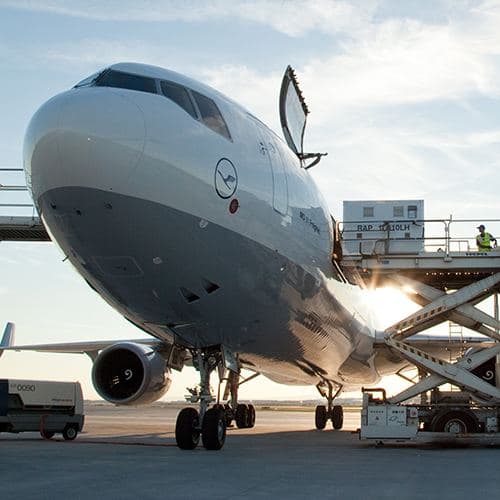
Cargo City Nord at Frankfurt Airport covers an area of 51 hectares. The largest company on site is Lufthansa Cargo AG. Its fleet of 18 aircraft of its own is stationed here, and most of the nearly eight billion freight ton-kilometers per year are handled from here. In addition to its own aircraft, a further 350 so-called belly aircraft, i.e. passenger aircraft operated by Lufthansa and other airlines, serve 361 destinations worldwide. A wide variety of freight is received or dispatched in areas such as "Cool", "Safe" or "Live". Some of it reaches its final destination in Frankfurt. Most of it, however, is unpacked from specially developed containers or pallets, recombined, repacked and transported on to the next destination. Behind so much logistics there is also a great deal of intralogistics, for which Lufthansa Cargo operates 120 forklifts and tow tractors from Mulag, Hyster, Still, Kalmar and Rofan.
Working together for greater safety and efficiency
Thomas Müller has worked in the systems landscape for materials handling equipment at the Frankfurt site for more than twenty years. And his collaboration with Volker Quirin, the developer of the manufacturer-independent fleet management system "Mobile Easykey", goes back almost as far. In a sense, Thomas Müller supplied the idea for it: "In training sessions, we showed employees how much money we spend in a year on damage caused by misuse to forklifts, tow tractors, racking and so on. But it did not help. As soon as an accident had been caused, colleagues simply left the machine standing where it was." Kurt Böcher, the occupational safety coordinator, adds: "Colleagues needed to know that we know who caused the accident. That was the beginning of considerably improved occupational safety." In the beginning, "Mobile Easykey" was not a closed system but a large number of individual components that were fitted to the forklift. Thomas Müller recalls: "I told Volker Quirin to put it all in one box. It was too cluttered for me." A few weeks later, the first "Mobile Easykey" module was ready for trial use on two forklifts, on which damage caused by misuse was halved during the test phase. Access via RFID transponder immediately made employees much more careful.
Using the software, it was now possible to determine on the machine who had driven the forklift and when. Simply walking away was no longer an option. The next evolutionary stages of "Mobile Easykey" were also planned in close cooperation with Lufthansa Cargo. Thomas Müller: "If they have an accident, they have to stop." This wish led to the "Crash Sensor", a dual system consisting of a structure-borne sound microphone and a motion sensor. Thomas Müller: "Reading out the modules after an accident was only permitted in the presence of a works council member. That was and is part of the works agreement. Today I would go so far as to say that without the new data protection concept with the dual works council password and the individual operating rights, Mobile Easykey would no longer exist here."
At peak times, the fleet even comprised 149 machines. All of them were equipped with "Mobile Easykey". And the trend from the test phase was confirmed: the costs incurred through damage caused by misuse were halved. Automatic shutdown was added later. It led to lower costs through reduced energy consumption.
The system kept evolving
For 20 years, Thomas Müller had the modules transferred to new forklifts whenever the old ones were replaced. The system, however, kept evolving. Some of this could be retrofitted, such as data transmission via mobile network. Until then, Thomas Müller had to ride regularly through the halls on a converted cargo bike and read out the modules manually using a notebook and a cable. At some point, the first modules reached the end of their service life, and the fact that the software, the "Mobile Easykey Manager", was no longer compatible with the old hardware led to the decision in 2019 to convert all vehicles to the current "modular crash+remote" with WLAN data transmission.
The implementation took just six months. Dr. Ralf Hölper, team leader of technical repair at Lufthansa Cargo: "It went just the way you would want it to. Everything worked perfectly. And during ongoing operations, too." The vehicles were recorded in the old software from 2005; the data could be migrated to the current version. After installation, the digital crash sensors were "taught in". Whereas the sensitivity of the first-generation sensors could only be adjusted directly on the machine based on experience, today it is possible to collect data on floor conditions and individual use over any period of time. For each individual machine, these values lead to meaningful thresholds at which a crash is triggered and the vehicle is immobilized, or, for less severe impacts, initially only an entry is made in the software's logbook.
The new focus is on data
A great deal has changed since the conversion to the latest module generation. Where "Mobile Easykey" was once perceived as reliable hardware, the focus today is on the data gained. "Now we are starting with real fleet management. We are working on topics such as indoor positioning and utilization analyses for process planning. For this, we get valuable data from the 'Mobile Easykey' software," says Dr. Ralf Hölper.
Photo: Lufthansa Cargo · Success story taken over from the previous website.
„It went just the way you would want it to. Everything worked perfectly. And during ongoing operations, too.“
Success story taken over from the previous website.